Posts

Showing posts with label wilderness. Show all posts

Wednesday, 12 February 2020

Against Anti-Nature

Crumbling Wall at Blaise Castle Estate, Bristol

“The natural features defended as our inalienable British heritage are almost always Victorian- the Highlabd deer-scapes of Landseer, the stone-walled crofts of the Wool Boom, the hedges and fields of the Encosure Acts, grouse moors canalized rivers, even mature forestry plantations.”- Isabella Tree, Wilding, p.299

            I see the aftershock of the Victorians in almost ever gardening job I have done. The cultivation and primness of lawns of grass, a pointless and over-abundant crop… The disfiguring of trees and shrubs to make aesthetic, geometrically shaped hedges. The treatment of weeds, moss and bramble as placeless, plants with no sanctioned existence despite their various merits and niches. The fuss over ‘waste’- fallen leaves, fruits, branches, blossoms and other decompostable material.  As a gardener, I offset my desire to be close to nature and in the outdoors with he mutilation I am required to mete out to it in order to receive a wage.
Clearing all of the soft, golden leaves from underneath an oak tree feels like shaving a bear in the height of winter; at the onslaught of a stressful season we remove the trees detritus, which would blanket the soil encasing the roots, break down into said soil providing nutrients to the tree and the flora and fauna of the soil that aid the tree such as worms and mychorrizae. We remove the leaves because they look ‘messy’. Clients don’t realize when their trees die, that they could have lived for millennia if not for the pruning and fussing being attended to it.
            In schools and other sites, the neatness of Victorian nature and gardening has been coded into health and safety legislation; while vital, it can sometimes be overboard. (In the case of pathways being blocked etc. there should be no argument against; if I, an able bodied person am allowed to move freely then so should anyone be, no matter their disability.) there aren’t allowed to be slip hazards on concrete, no low branches, no toxic plants; minimized risk means maximised monoculture.
            We are absorbed by the aesthetic to the point we forget about the lives we manipulate to create it; this comes to head with the current market for astroturfed domestic lawns. It’s a plastic weave that eventually comes apart and sheds, absorbs no water; and must one day be replaced despite being non-recyclable. But you can have a barbecue on it, look out your window and see green. We have convinced ourselves a prototype, an imprint, a mould, is better than the real thing. (I’m eating my own tail here- I earlier argued against lawns, but they’re better than plastic! That being said it would be much better if you let your grass grow wild, or swap it for something that feeds you or nature.)
            ‘Lazy’ and ‘wild’ gardening, especially for crops, is becoming more popular, and to good measure- as all eras must be born anew from the previous, there must also be meditation on lessons best learnt from the past. A deconstruction of what was once known for the building of what we now know.

Monday, 3 July 2017

Lives in our Death: Rewilding for a Post-Human World.


Apocalyptic visions are getting harder and harder to ignore in the 21st century; they’re embedded densely in popular culture, the media frequently leans towards intense catastrophic fear-mongering, and many experts are espousing troubling theories about the nearing end-times, including the man who conceived of the ‘Gaia’ hypothesis, James Lovelock.
            Instead of spurring a drive towards correction, this kind of embedded fear has all too often led to frantic action and bizarre offsetting of fear; Slavoj Žižek observes that in the face of impending sea level rises and the loss of both ice caps, people are instead attracted to (and fed by the media) stories about possible carbon-saving boat travel across the newly created Arctic sea, or the possiblility of Antarctica as an entirely new plain to colonise. This impedes the kind of radical environmental action massively; people are either happy to continue with business as usual or are too pessimistic to do anything proactive.
            Rewilding is definitely proactive and radical; it suggests a drastic change in our approach to natural landscapes to just leave them be, or to reinstate vital aspects of ecosystems that we have helped eradicate (such as large predators) to enable them to be self-sufficient. Many, including George Monbiot in his seminal book on rewilding in Britain, entitled Feral, espouse human-oriented arguments that delve into the spiritual and the economic. I believe that, especially in the case of humans becoming extinct, rewilding is essential simply for the planet.
            As the global landscape stands, especially in Europe, where there are animals, there are fences. We alone can permeate these fences; we bring the animals their feed, we rake away their droppings. The space animals, especially livestock, are allowed to occupy is a liminal space, often without natural function. The same can be observed in some ‘wild’ and natural spaces; conservation organisations created ‘natural disturbance’ to manage the lives of the animals therein, also most likely fenced in. What happens to these animals when we die?
            Presumably, they also die. Without a supply of food, surrounded by their own muck and often separated from breeding partners, these animals will die, and rot, and provide food for the scavenging few that can even make it past the fence such as birds or insects. If this was a rewilded or truly wild space, it would be self-sufficient and naturally functioning. Animal carcasses would of course be present in the landscape, but they would be integrated into the natural processes present just as should occur in the wilderness. Species can roam, breed, interact, spread, just as animals and plants naturally do; they are fluid.

Although the lifetime of a fence is far greater than their own lives, the chance we would give them to be able to live and breed for generations yet to come before the fence finally falls is still a whole lot better than the meagre chance afforded to our pets, zoo occupants, livestock, pitiful nature reserves. To not think of the lives of those we implicate in our own past our species’ extinction is as absurd as assuming that when you die, everyone else dies. Besides, through proactive rewilding, we might even solve some of the apocalyptic issues currently plaguing our planet such as carbon emissions, deforestation, and the terrifying loss of biodiversity the world over.

Sunday, 30 April 2017

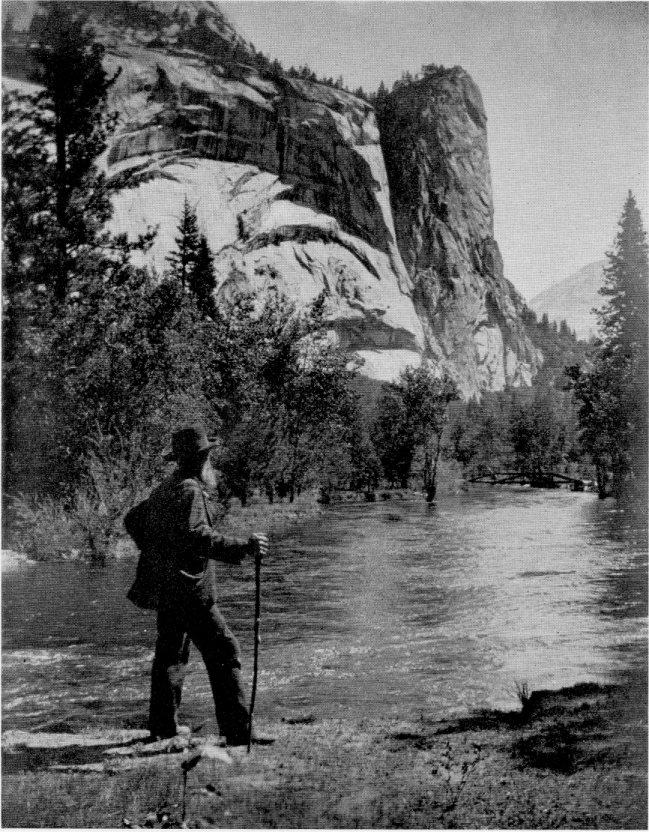
“Perhaps if I knew them better I should like them better.” John Muir, People and Native Americans in 'My First Summer in the Sierra.'


As someone interested in history, in the environment, in wilderness, conservation, and writing, I am ashamed to say that I just learned about John Muir, the late 19th century Scottish- American naturalist, last month. From a comic. Muir is famed for petitioning the U.S government for the creation of Yosemite national park, and also for his involvement in the Sierra club and other moves for conserving wilderness in the U.S. I decided to read the only of Muir’s books my library had on offer, My First Summer in the Sierra, to dip into oldey-timey conservation and naturalist writing, hoping to find connections and optimism for movements today.
            It is hard not to feel deeply for the environment as Muir sees it; he admires all life, even the ferocious bears and irritating Douglas squirrel, and laments the very undergrowth that the flock of sheep he accompanies lays waste in its trampling past. It is no surprise then, that he feels deeply the wound capitalism has created between man and the ever-connected and brotherly web of nature he sees before him. This occurs mainly in his observations of Shepherds in California, whom are degraded and exhausted by their economic strife, and may only be driven by hopes of escalating in the capitalist system by saving up to buy a flock of their own. I can think of no better summarizing image than the one Muir paints of Billy, the shepherd he accompanies, who’s clothing becomes entirely coated over time with the greasy, fatty dripping of the lunch he ties to his belt, meaning that “instead of wearing thin [his trousers] wear thick.” Billy has no emotional connection to the sheep, remarking often when one goes astray that he is not paid enough to keep saving them.
            It is thus greatly surprising, considering Muir’s deep-felt empathy for nature and his lamentations about the Arcadian shepherd being broken by American capitalism, to read his shocks and spites for Native Americans, in this era still referred to widely as ‘Indians.’ From the off Muir writes of the feeble and weak ‘Digger Indians,’ who are never specified by tribe, culture or nation, instead just a taxonomic ugliness akin to the South African settler’s naming of the ‘bushman.’ Muir frequently writes of the Indians sustenance on nature, of which he is jealous of as he and his colleagues must rely on deliveries of bread and other supplies which runs dry for an uncomfortable time. He also writes of their skill in living in their environment, as he is startled a few times by the sudden and silent appearance of a Native in their camp. Despite these admirations, he still affords them little acknowledgement for their ingenuities. He remarks on their ragged clothing, their begging for whiskey or tobacco, without really acknowledging the corrupting effect of white capitalist invasion in the same way he affords the white shepherd.
            I am sure there are a number of ways to understand his perception of native Americans, but I find it most hard to digest as a result of his perceived special ‘Scotchness,’ which I feel Muir stresses to tie him stronger to nature within the capitalist systematics of shepherding in California. When commenting on the Californian shepherds ill education, grimy food and overall depressing life, he compares it to the Scottish shepherd, whom he praises alongside the ‘Oriental shepherd’ for maintaining a keen intellect and interest in culture. Muir also retells an event where, in the dead of night, he ‘felt’ that a friend of his was nearby, and in the morning found that his friend was indeed in the valley he felt him to be in, to everyone’s surprise. This is written as being an event of extraordinary ‘Scotch farsightedness.’ I want to believe that, as result of his belief in himself as Scottish and thus different in culture etc. to other Europeans, Muir would understand other cultural uniquenesses and admire them in the same way he would admire a forested valley. I am no great scholar of Muir, but I feel that, between his heightened Scottishness and his flippancy towards the fascinating lives of Indians who understand and admire their environments as much as, if not more, than muir, exists the kind of Celtic, white-supremacist mythologizing that helped spawn various blights to the development of American culture(s) such as the Southern confederacy, which borrowed the very flag design of Scotland for their own, and also the Ku Klux Klan, who borrowed the symbolism of the 'clan' for their own twisted ends. Like I said, I am not great scholar of Muir, and also never knew him personally, but on closer critical reading I have dug up this dull residue of his understanding of the Natives of the wild lands he so greatly admires.

            I have written the above without even dipping into his mentionings of ‘Chinamen,’ some vague myths he recounts of Indian surrenders, and also an event in passing that was of interest to me, wherein he claims to have enjoyed the company of a general of the Florida Seminole wars, one of many wars between white invader and Native Americans.

Tuesday, 21 March 2017

Thylacine


Here is a poem for world poetry day- I wrote it yesterday after watching some footage one of the last Tasmanian tigers.

Brain; neurons; eyes; glasses lens;
air (microbes, atoms, molecules);
screen protector; screen; video of you;
 84 years; camera film; light; camera lens;
air (microbes, atoms, molecules);
you. Your fur your big head your teeth. The markings on your fur;
I don’t have those, we don’t have those, you had those.
Your snout your eyes your pouch for your young.
Once your were as simple as a raindrop, a spec of sand;
Now you are a fissure of crystal, a double-helix ballet.
You are dead , and alive on my screen,
Removed from you, I do not feel your evident pain.
With you removed, a hole becomes evident, somewhere.

picture from: http://nnimgt-a.akamaihd.net/transform/v1/crop/frm/382X9zPWq9wRtCgUsbmhcAx/511c15d6-61e2-4631-91bb-009458f522e7.jpg/r0_0_1200_675_w1200_h678_fmax.jpg

Sunday, 12 March 2017

Reintroducing predators or emulating them; the missing ecological relationship in Britain.

            Near Horsham in West Sussex is a castle estate called ‘Knepp Estate,’ which, alongside farming, has let a great deal of the estate return to the wild. Medium-sized herbivores such as longhorn cattle, roe and fallow deer, Exmoor ponies and pigs roam freely on the estate. So far, these rewilding techniques have regenerated the soil’s nutrient quality, making farming once again viable near the site, whereas traditional intensive farming had rendered the soil unworkable without large quantities of chemical fertiliser; farming is finally profitable once again in the area.
            The benefits of rewilding are numerous; vastly increased biodiversity and carbon sequestration, as well as social benefits such as those George Monbiot wrote about in Feral; the sense of adventure and wonder that is lost without true, unadultered wilderness. The cause of this article is not to reiterate these benefits. I am simply looking at a common cause for human intervention in rewilding projects; fencing out or culling herbivores.
Knepp estate has had to fence off certain areas of land to guarantee that young trees and other vegetation will survive undamaged by the grazing and browsing habits of the herbivores present. It is the intensive grazing of the ‘white plague’ of sheep and other large herbivores such as deer and cattle, kept for commercial use, that has helped transform the British Isles into monolithic and expansive grassland. As a natural process in a pre-human past, grazing and other herbivorous habits helped create mosaic-like environments of grassland, scrub and woodland believed to have existed in the Pleistocene era. In the Pleistocene, however, there were predators to maintain herbivore population and also their behaviours and approaches to their environment. The herbivores that existed were also diverse in species and especially size, with even Britain hosting megafauna; the skeletons of ancient hippopotami have been found underneath central London. Interestingly enough, Knepp Estate’s aims are to add more species of herbivore, to include elk and bison.
            Dundreggan, an area that rewilding organisation Trees For Life have been working on in the Scottish Highlands, has had success by fencing out the red deer that are endemic to the area. The result has been a surge in young tree growth and inception, sometimes species that one wouldn’t expect to find, all without much human planting necessary. The biodiversity in the area is vibrant, with more than 3,000 new species recorded in Dundreggan alone. The area is lacking a natural predator, specifically the wolf; were a wolf present, the organisation would no longer need to fence out the deer, as the wolves would maintain their population by preying on the weak and sickly deer, altering the deer behaviour by scaring them away from open spaces, such as open land on the fringes of forests, and also stretches of open water where a deer may be more at risk. This has a chain reaction, that has been highlighted with the reintroduction of wolves to Yellowstone National Park in America; as the deer left open water alone, trees were allowed to grow along the waters edge, shading and cooling down the water, making it habitable for fish and other animals which helped filter the water of impurities. Knepp estate fenced off an area of newly-planted trees along the Adur river, to eventually grow to cover the water and cool it down, in a venture the Ouze & Adure River Trust termed ‘trees for trout,’ and effect which  Yellowstone has achieved through the reintroduction of natural predators.

 Tree Planting Along the River Adur at Knepp Estate. Author’s own image.


Trees for life currently run a volunteering programme called ‘project wolf’ wherein volunteers emulate wolf behaviour to scare deer away from the vulnerable rewilded areas. Many concerned with reintroducing a natural predator to the British Isles have claimed that the Eurasian lynx would be the least problematic predator to reintroduce to the British wild lands. With a Pleistocene rewilding project such as Knepp Estate, what predator should be present? If one could be decided upon, in this present day with many stakeholders in rural areas so set against the reintroduction of predators, could it be emulated, such as the project wolf campaign? The estate already cull their animals to maintain a natural population, and so the need for a natural predator has not gone unobserved. Species are being reintroduced in Britain, albeit at a slow pace, and the predator question is enshrouded in cultural myths of fear, which forces rewilding organisations to sadly intervene where another ecological relationship has been persecuted and removed over time.

Referenced: