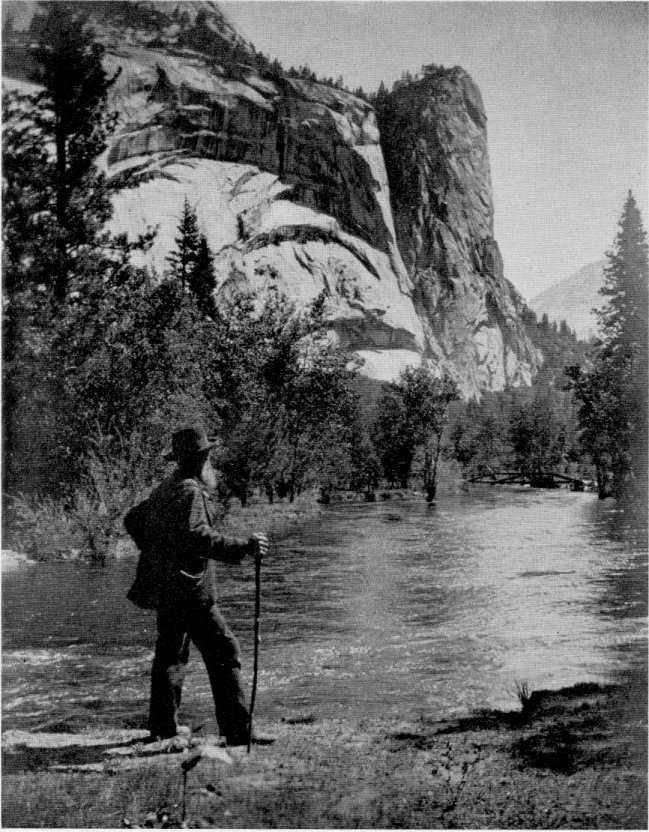
As someone interested in history,
in the environment, in wilderness, conservation, and writing, I am ashamed to
say that I just learned about John Muir, the late 19th century
Scottish- American naturalist, last month. From a comic. Muir is famed for
petitioning the U.S government for the creation of Yosemite national park, and
also for his involvement in the Sierra club and other moves for conserving
wilderness in the U.S. I decided to read the only of Muir’s books my library
had on offer, My First Summer in the
Sierra, to dip into oldey-timey conservation and naturalist writing, hoping
to find connections and optimism for movements today.
It is hard
not to feel deeply for the environment as Muir sees it; he admires all life,
even the ferocious bears and irritating Douglas squirrel, and laments the very
undergrowth that the flock of sheep he accompanies lays waste in its trampling
past. It is no surprise then, that he feels deeply the wound capitalism has
created between man and the ever-connected and brotherly web of nature he sees
before him. This occurs mainly in his observations of Shepherds in California,
whom are degraded and exhausted by their economic strife, and may only be
driven by hopes of escalating in the capitalist system by saving up to buy a
flock of their own. I can think of no better summarizing image than the one
Muir paints of Billy, the shepherd he accompanies, who’s clothing becomes
entirely coated over time with the greasy, fatty dripping of the lunch he ties
to his belt, meaning that “instead of wearing thin [his trousers] wear thick.”
Billy has no emotional connection to the sheep, remarking often when one goes
astray that he is not paid enough to keep saving them.
It is thus
greatly surprising, considering Muir’s deep-felt empathy for nature and his
lamentations about the Arcadian shepherd being broken by American capitalism,
to read his shocks and spites for Native Americans, in this era still referred
to widely as ‘Indians.’ From the off Muir writes of the feeble and weak ‘Digger
Indians,’ who are never specified by tribe, culture or nation, instead just a
taxonomic ugliness akin to the South African settler’s naming of the ‘bushman.’
Muir frequently writes of the Indians sustenance on nature, of which he is
jealous of as he and his colleagues must rely on deliveries of bread and other
supplies which runs dry for an uncomfortable time. He also writes of their
skill in living in their environment, as he is startled a few times by the
sudden and silent appearance of a Native in their camp. Despite these
admirations, he still affords them little acknowledgement for their
ingenuities. He remarks on their ragged clothing, their begging for whiskey or
tobacco, without really acknowledging the corrupting effect of white capitalist
invasion in the same way he affords the white shepherd.
I am sure
there are a number of ways to understand his perception of native Americans,
but I find it most hard to digest as a result of his perceived special ‘Scotchness,’
which I feel Muir stresses to tie him stronger to nature within the capitalist
systematics of shepherding in California. When commenting on the Californian
shepherds ill education, grimy food and overall depressing life, he compares it
to the Scottish shepherd, whom he praises alongside the ‘Oriental shepherd’ for
maintaining a keen intellect and interest in culture. Muir also retells an
event where, in the dead of night, he ‘felt’ that a friend of his was nearby,
and in the morning found that his friend was indeed in the valley he felt him to be in, to everyone’s surprise. This is
written as being an event of extraordinary ‘Scotch farsightedness.’ I
want to believe that, as result of his belief in himself as Scottish and thus
different in culture etc. to other Europeans, Muir would understand other
cultural uniquenesses and admire them in the same way he would admire a
forested valley. I am no great scholar of Muir, but I feel that, between his
heightened Scottishness and his flippancy towards the fascinating lives
of Indians who understand and admire their environments as much as, if not
more, than muir, exists the kind of Celtic, white-supremacist mythologizing
that helped spawn various blights to the development of American culture(s)
such as the Southern confederacy, which borrowed the very flag design of Scotland for their own, and also the Ku Klux Klan, who borrowed the symbolism of the 'clan' for their own twisted ends. Like I said, I am not great
scholar of Muir, and also never knew him personally, but on closer critical
reading I have dug up this dull residue of his understanding of the Natives of
the wild lands he so greatly admires.
I have
written the above without even dipping into his mentionings of ‘Chinamen,’ some
vague myths he recounts of Indian surrenders, and also an event in passing that
was of interest to me, wherein he claims to have enjoyed the company of a
general of the Florida Seminole wars, one of many wars between white invader
and Native Americans.