Posts

Showing posts with label history. Show all posts

Friday, 26 June 2026

Slain


1066- No King
Standing
In Engleterre.

Hardrada dead at the bridge.
To Godwinson's eye an arrow-
But not far on the same plain, a spear to his thigh,
The bastard.

In the fields and uncounted forests
And muddy streets
The English are afraid;
What God
Fates slaughter
Of the crown usurpers
And the annointed King
In the same calendar month?

Unbothered,
Courts across the water
Continental and swarming
Count their silver
And take a greater interest

In that island.


Saturday, 3 June 2017

Mahana: Taking in the backdrop


The main story of Mahana directed by Lee Tamahori is a drama of past romance, a coming-of-age tale, and a tale of rural New Zealand in the 1960s. I do not with to spoil the plot, but more importantly wish to look through this, into the thriving backdrop of culture and environment that pervades the film, based on one of the acclaimed Maori novelist Witi Ihimaera’s books.
            In a colonial and a postcolonial setting, where people are from is important, and speaks volumes about their perception of the world, and their place in it. It oddly took me a while to see the structure of race and culture present in Mahana’s rural mid-twentieth century New Zealand; the main story looks at a rivalry between two Maori Iwi’s (family groups), the titular Mahanas and the Poatas. While these two groups squabble and struggle against one another, the white employers, mostly shown in the character Collins, can take a back seat; they have guaranteed employment, why should they be involved? Indeed, the arguments between the Poatas and the Mahanas incorporate the contracts given out by the white man.


Although the patriarchal grandfather Temehana Mahana owns lands, it is accentuated that he started from nothing, and seeks out contracts for employment from white employers anyway. It is thus interesting that young Simeon and his peer group are so interested in American culture, particularly cowboy films featuring the likes of John Wayne; although in Mahana, the Maoris represented are the cowboys, in the cowboy films native Americans are the enemy, and Maori’s likely suffered similar humiliations and defeats, resulting in the drastic assault on the landscape with European land tenure systems and livestock practices, namely sheep rearing, which the Mahanas have settled into reciprocating and maintaining. While the sheep munch away the environment, changing the landscape, there is a scene wherein the main characters are ‘reduced’ to scrub clearing; not only do they maintain the livestock which has changed the indigenous landscape, they are forced to become the changers of landscape to settle the need for cash income. The Maori culture is attacked in more overt ways throughout; the Maori language is not allowed to be spoken in court and Temehana is fiercely biblical.
 I am also interested in the character of Mr. McKenzie. McKenzie is Simeon’s teacher, and seems to be more progressive, taking Simeon under his wing, and encouraging him to be honest and true to himself. I wonder if the character of McKenzie could be anything other than a Scotsman; the same role filled in with an Englishman or a white New Zealander would have a flattened effect, as their dominance as a teacher would merely be accentuated; but the Scottish are different, they have a culture separate from the English and an ecological history that has been similarly assaulted by capitalist agriculture.


            I am merely flexing my thoughts on culture and environment in this piece, and regret that I do not go into the complexities of feminism apparent in the film; outside of New Zealand, the film was released under the title ‘the Patriarch,’ and it is accentuated throughout the domineering social structures that oppress women in society, both in the mid-twentieth century Maori society, and New Zealand society more broadly.

Sunday, 30 April 2017

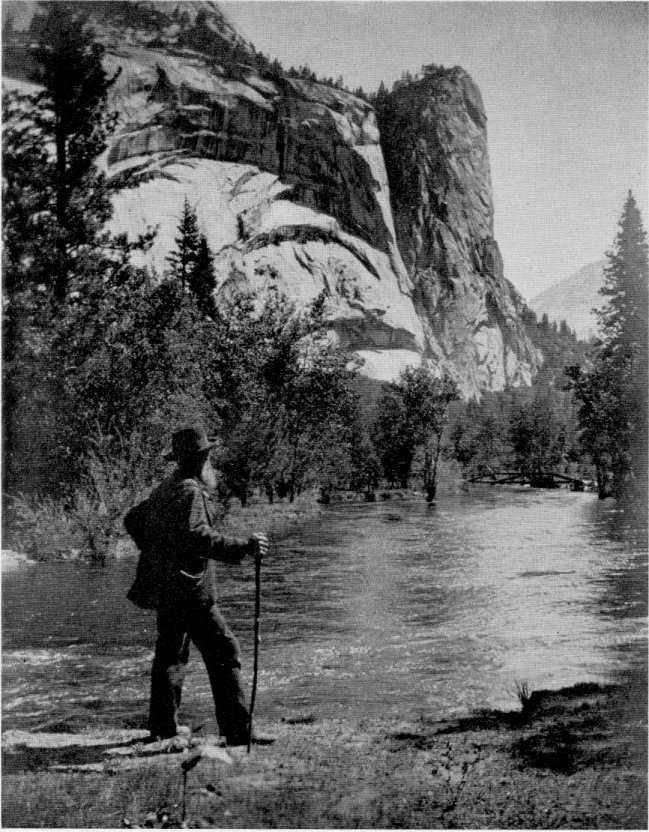
“Perhaps if I knew them better I should like them better.” John Muir, People and Native Americans in 'My First Summer in the Sierra.'


As someone interested in history, in the environment, in wilderness, conservation, and writing, I am ashamed to say that I just learned about John Muir, the late 19th century Scottish- American naturalist, last month. From a comic. Muir is famed for petitioning the U.S government for the creation of Yosemite national park, and also for his involvement in the Sierra club and other moves for conserving wilderness in the U.S. I decided to read the only of Muir’s books my library had on offer, My First Summer in the Sierra, to dip into oldey-timey conservation and naturalist writing, hoping to find connections and optimism for movements today.
            It is hard not to feel deeply for the environment as Muir sees it; he admires all life, even the ferocious bears and irritating Douglas squirrel, and laments the very undergrowth that the flock of sheep he accompanies lays waste in its trampling past. It is no surprise then, that he feels deeply the wound capitalism has created between man and the ever-connected and brotherly web of nature he sees before him. This occurs mainly in his observations of Shepherds in California, whom are degraded and exhausted by their economic strife, and may only be driven by hopes of escalating in the capitalist system by saving up to buy a flock of their own. I can think of no better summarizing image than the one Muir paints of Billy, the shepherd he accompanies, who’s clothing becomes entirely coated over time with the greasy, fatty dripping of the lunch he ties to his belt, meaning that “instead of wearing thin [his trousers] wear thick.” Billy has no emotional connection to the sheep, remarking often when one goes astray that he is not paid enough to keep saving them.
            It is thus greatly surprising, considering Muir’s deep-felt empathy for nature and his lamentations about the Arcadian shepherd being broken by American capitalism, to read his shocks and spites for Native Americans, in this era still referred to widely as ‘Indians.’ From the off Muir writes of the feeble and weak ‘Digger Indians,’ who are never specified by tribe, culture or nation, instead just a taxonomic ugliness akin to the South African settler’s naming of the ‘bushman.’ Muir frequently writes of the Indians sustenance on nature, of which he is jealous of as he and his colleagues must rely on deliveries of bread and other supplies which runs dry for an uncomfortable time. He also writes of their skill in living in their environment, as he is startled a few times by the sudden and silent appearance of a Native in their camp. Despite these admirations, he still affords them little acknowledgement for their ingenuities. He remarks on their ragged clothing, their begging for whiskey or tobacco, without really acknowledging the corrupting effect of white capitalist invasion in the same way he affords the white shepherd.
            I am sure there are a number of ways to understand his perception of native Americans, but I find it most hard to digest as a result of his perceived special ‘Scotchness,’ which I feel Muir stresses to tie him stronger to nature within the capitalist systematics of shepherding in California. When commenting on the Californian shepherds ill education, grimy food and overall depressing life, he compares it to the Scottish shepherd, whom he praises alongside the ‘Oriental shepherd’ for maintaining a keen intellect and interest in culture. Muir also retells an event where, in the dead of night, he ‘felt’ that a friend of his was nearby, and in the morning found that his friend was indeed in the valley he felt him to be in, to everyone’s surprise. This is written as being an event of extraordinary ‘Scotch farsightedness.’ I want to believe that, as result of his belief in himself as Scottish and thus different in culture etc. to other Europeans, Muir would understand other cultural uniquenesses and admire them in the same way he would admire a forested valley. I am no great scholar of Muir, but I feel that, between his heightened Scottishness and his flippancy towards the fascinating lives of Indians who understand and admire their environments as much as, if not more, than muir, exists the kind of Celtic, white-supremacist mythologizing that helped spawn various blights to the development of American culture(s) such as the Southern confederacy, which borrowed the very flag design of Scotland for their own, and also the Ku Klux Klan, who borrowed the symbolism of the 'clan' for their own twisted ends. Like I said, I am not great scholar of Muir, and also never knew him personally, but on closer critical reading I have dug up this dull residue of his understanding of the Natives of the wild lands he so greatly admires.

            I have written the above without even dipping into his mentionings of ‘Chinamen,’ some vague myths he recounts of Indian surrenders, and also an event in passing that was of interest to me, wherein he claims to have enjoyed the company of a general of the Florida Seminole wars, one of many wars between white invader and Native Americans.

Tuesday, 21 March 2017

Thylacine


Here is a poem for world poetry day- I wrote it yesterday after watching some footage one of the last Tasmanian tigers.

Brain; neurons; eyes; glasses lens;
air (microbes, atoms, molecules);
screen protector; screen; video of you;
 84 years; camera film; light; camera lens;
air (microbes, atoms, molecules);
you. Your fur your big head your teeth. The markings on your fur;
I don’t have those, we don’t have those, you had those.
Your snout your eyes your pouch for your young.
Once your were as simple as a raindrop, a spec of sand;
Now you are a fissure of crystal, a double-helix ballet.
You are dead , and alive on my screen,
Removed from you, I do not feel your evident pain.
With you removed, a hole becomes evident, somewhere.

picture from: http://nnimgt-a.akamaihd.net/transform/v1/crop/frm/382X9zPWq9wRtCgUsbmhcAx/511c15d6-61e2-4631-91bb-009458f522e7.jpg/r0_0_1200_675_w1200_h678_fmax.jpg

Monday, 16 January 2017

The history-mining reader in J.M. Coetzee’s The Childhood of Jesus.


The fallabilities of recording and understanding history are not new field of J.M. Coetzee’s writings; “the Narrative of Jacobus Coetzee,” the latter story of his debut Dusklands presents us with a fractured yet whole history; fractured in the different reports and pieces of the narrative as a whole left out, but whole in its presentation; a first person narrative, an appendix from a fictitious descendant of Jacobus, and other add-ons (the use of J.M. Coetzee’s surname for the main character may also be seen as a conscious anchoring of the fictitious history in real history, forcing the reader to judge for themselves.) Later, in Waiting for the Barbarians, we are presented with an unlodged and nebulous environment, in an unnamed land populated by the denizens of ‘the Empire’ and also the mysterious ‘barbarians.’ Here history is a straining force; the barbarians alien approach to time and the importance of history can be unsettling.
            Coetzee’s 2013 novel The Childhood of Jesus has a similar unlodged setting, but on a much more drastic scale. I have read some reviews that glance over this, claiming that it is Coetzee simply moving aside the humdrum lynchings of story, setting and other extrapalative description to make room for philosophical waxing in the novel, and space for the reader’s interpretations to blossom upon unanswered and often unspoken questions presented throughout. I believe that this unlodging of history and environment, being unusual in texts, forces the reader, through their discomfort, to mine for histories that are not there.
            The Childhood of Jesus feels very open in terms of space, yet is populated with many characters. The space in question is an unnamed land, where Spanish is spoken, (a similar confusion created as when Coetzee used his own surname for Jacobus?) or, more accurately, the populace has to speak Spanish, as we learn that Simón and David had to learn Spanish on the boat to Novilla, the main city. We know that Simón and David came by boat, from a camp called ‘Belstar,’ and that is about as far back for either of them that we are given. We are allowed some insights into these journeys; David loses a document on the boat supposedly detailing who his parents are, which is how he meets Simón, and Simón comments that the portmaster at Belstar will only allow boats out, not back to Belstar.
            The main characters are the only two we ever really get even a shallow insight into. The other Stevedores that Simón works with at the docks at Novilla engage only in the present, to the extent that they are dubious of ‘moving with the times’ and using a crane to save their heavy lifting, or to acknowledge the accumulation of the days upon days of shipping grain to a store that is overflowing and infested with rats. The epitome of such misplacement of past or future thought is Senór Daga, who acts with no understanding of consequence; he robs and engages in violence, and generally seems to float through his life.
            As such, the reader latches onto the small details we are afforded. David’s history, at least for the most part, we get to witness being built, but Simón’s we have not witnessed. We know small details; he had to learn Spanish, he can drive, his father pushed him high on the swing but he never fell off as a child, we know his hands were soft before becoming a stevedore and we know he is middle aged. This is the most we ever really get to know about any character; Coetzee offers us a line into Inés’ past when Simón says of her past at the luxurious ‘La Residencia; “I have no idea what it was like. I have never understood La Residencia or how you landed up there.” Alas, Inés “does not hear the question, or does not think it worthy of reply.” (Coetzee, p.312) Although it is mainly stressed with Simón and David, it is suggested that every character met is not native to this land, that they too had a history elsewhere, but are now fixed into the present, somehow landing up wherever they landed up, Inés in La Residencia, and Simón and David in the blocks.
            The novel ends with a group of characters breaking free of Novilla and the small and barren satellite towns it grows, onward to the town of ‘Estrillata el Norte.’ (Even the place names appear unlodged from a past or hint at environment; “They strike a town name Laguna Verde (why?- there is no lagoon)”) (Coetzee, p.310) Where they will cut off the short history the reader has been allowed an insight to, namely the histories of the characters in Novilla, thus denying the reader even the relevance of this short record. However, Coetzee’s latest book is a sequel entitled The Schooldays of Jesus, and so we shall have to see what residue of history we can drag across the gap.

Cited:

Coetzee, J.M. The Childhood of Jesus. (London: Vintage, 2014)