Posts

Saturday, 3 June 2017

Mahana: Taking in the backdrop


The main story of Mahana directed by Lee Tamahori is a drama of past romance, a coming-of-age tale, and a tale of rural New Zealand in the 1960s. I do not with to spoil the plot, but more importantly wish to look through this, into the thriving backdrop of culture and environment that pervades the film, based on one of the acclaimed Maori novelist Witi Ihimaera’s books.
            In a colonial and a postcolonial setting, where people are from is important, and speaks volumes about their perception of the world, and their place in it. It oddly took me a while to see the structure of race and culture present in Mahana’s rural mid-twentieth century New Zealand; the main story looks at a rivalry between two Maori Iwi’s (family groups), the titular Mahanas and the Poatas. While these two groups squabble and struggle against one another, the white employers, mostly shown in the character Collins, can take a back seat; they have guaranteed employment, why should they be involved? Indeed, the arguments between the Poatas and the Mahanas incorporate the contracts given out by the white man.


Although the patriarchal grandfather Temehana Mahana owns lands, it is accentuated that he started from nothing, and seeks out contracts for employment from white employers anyway. It is thus interesting that young Simeon and his peer group are so interested in American culture, particularly cowboy films featuring the likes of John Wayne; although in Mahana, the Maoris represented are the cowboys, in the cowboy films native Americans are the enemy, and Maori’s likely suffered similar humiliations and defeats, resulting in the drastic assault on the landscape with European land tenure systems and livestock practices, namely sheep rearing, which the Mahanas have settled into reciprocating and maintaining. While the sheep munch away the environment, changing the landscape, there is a scene wherein the main characters are ‘reduced’ to scrub clearing; not only do they maintain the livestock which has changed the indigenous landscape, they are forced to become the changers of landscape to settle the need for cash income. The Maori culture is attacked in more overt ways throughout; the Maori language is not allowed to be spoken in court and Temehana is fiercely biblical.
 I am also interested in the character of Mr. McKenzie. McKenzie is Simeon’s teacher, and seems to be more progressive, taking Simeon under his wing, and encouraging him to be honest and true to himself. I wonder if the character of McKenzie could be anything other than a Scotsman; the same role filled in with an Englishman or a white New Zealander would have a flattened effect, as their dominance as a teacher would merely be accentuated; but the Scottish are different, they have a culture separate from the English and an ecological history that has been similarly assaulted by capitalist agriculture.


            I am merely flexing my thoughts on culture and environment in this piece, and regret that I do not go into the complexities of feminism apparent in the film; outside of New Zealand, the film was released under the title ‘the Patriarch,’ and it is accentuated throughout the domineering social structures that oppress women in society, both in the mid-twentieth century Maori society, and New Zealand society more broadly.

Tuesday, 30 May 2017

A&E: a brief journal


I fell in love with the waiting room yesterday. The sort of place that usually makes me squirm and broil with general upset was suddenly a constant source of fascination. Perhaps my eyes were opened to this because I wasn’t in need of attention (my girlfriend possibly broke a bone in her hand) and also I was extremely hungover so all I really wanted was somewhere to sit and focus on nothing, possibly sleep, all of which was granted to me.
            On arriving in the taxi, we see three women waiting for a lift away. They were dressed in beautiful and precisely worn headscarves and shawls, of deep and satisfying colour and pattern. Inside, hospital staff are everywhere and attempting to get everywhere, in their various coloured scrubs with embroidered meanings on the back. It occurred to me suddenly that this place is never empty; the staff don’t close up shop when the last patient of the day leaves at 5pm sharp. The injured hordes will continually pour in, or stumble in at least (there seemed to be a lot of foot injuries.)
            The police appeared three times, an event that caught my attention as someone instantly alerted by sirens and their associated symbols. The first time they were dropping off a name and description at the reception. The second time, they brought in Barry, who was not under arrest; it appeared maybe he’d been found collapsed somewhere and they were helping them in. He looked like he’d had some form of stroke but it could’ve been something else. He wore a jumper back-to-front that should’ve had the Dr. Pepper logo on the front, but was instead of course on his back. Barry could not sit still; despite being told a number of times to remain in his seat by the patient staff, he would switch seats, converse with anyone, wander outside, wander down the hallways, and generally disappear. The third time the police appeared, they had someone in handcuffs. A short, unshaven man from the North, his arms covered in faded tattoos. From the conversations I caught between him and the officers, he was an alcoholic. He was obviously distressed, in his worn out blue t-shirt and grey jogging bottoms.

            There seemed to be quite a few Irish people working in the hospital and waiting for help. There was one Scottish man, in some deal of discomfort, with a young daughter who couldn’t sit still. She developed a slight fascination with the water cooler, and continually attempted to impress my girlfriend (who couldn’t care less what with the painful arm) with her acrobatic methods of getting onto and off of her chair. Inevitably Barry conversed with the child.

Wednesday, 17 May 2017

Some thoughts on WALL-E


            I can’t remember when I first saw WALL-E, but I definitely was under the age of 16. Rewatching it now, as a twenty-two year old student, I have realized what an ecological marvel it is; I was pointed to re-watch it in part by a brief analysis in Timothy Morton’s The Ecological Thought.
            I was struck by the overwhelming scale artificial objects were given; everything is gargantuan, such as the ship the Axiom, that blocks out the sky and is filled with unknowningly complex interior workings. Importantly, many giant things are defunct, and simply rubbish. A huge ‘Buy n Large Ultrastore’ sprawls in the urban wasteland, no longer used; enormous freighters are lined up in a row, rusting away and useless.
Most noticeably of all, the amount of waste rampant in the defunct planet is paradoxically larger than the environment it exists in, even in the compacted towers that WALL-E (and supposedly his deceased comrades) worked to turn it into. How can there be more waste than… well, anything else? We find this question crop up again later onboard the Axiom, where WALL-E is trapped in the waste disposal zone. Here, two giant robots work compacting the eternal stream of rubbish thrown into their compartment. Why would a ship with the purpose of conserving human life be so inefficient as to create so much waste?

Interestingly, the robots compacting waste on the Axiom are simply larger versions of WALL-E, suggesting that instead of solving the issue that has apparently followed humans onto the ship (i.e. over-consumption, wasteful lifestyles) humanity has simply upgraded the solution that was there, not necessarily solving anything, but with all the appearance of productivity.

Sunday, 30 April 2017

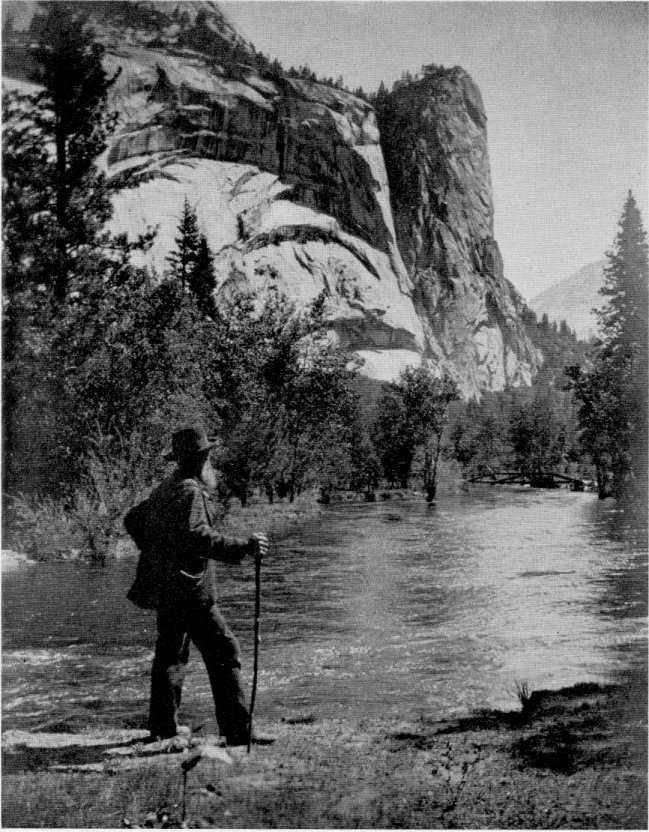
“Perhaps if I knew them better I should like them better.” John Muir, People and Native Americans in 'My First Summer in the Sierra.'


As someone interested in history, in the environment, in wilderness, conservation, and writing, I am ashamed to say that I just learned about John Muir, the late 19th century Scottish- American naturalist, last month. From a comic. Muir is famed for petitioning the U.S government for the creation of Yosemite national park, and also for his involvement in the Sierra club and other moves for conserving wilderness in the U.S. I decided to read the only of Muir’s books my library had on offer, My First Summer in the Sierra, to dip into oldey-timey conservation and naturalist writing, hoping to find connections and optimism for movements today.
            It is hard not to feel deeply for the environment as Muir sees it; he admires all life, even the ferocious bears and irritating Douglas squirrel, and laments the very undergrowth that the flock of sheep he accompanies lays waste in its trampling past. It is no surprise then, that he feels deeply the wound capitalism has created between man and the ever-connected and brotherly web of nature he sees before him. This occurs mainly in his observations of Shepherds in California, whom are degraded and exhausted by their economic strife, and may only be driven by hopes of escalating in the capitalist system by saving up to buy a flock of their own. I can think of no better summarizing image than the one Muir paints of Billy, the shepherd he accompanies, who’s clothing becomes entirely coated over time with the greasy, fatty dripping of the lunch he ties to his belt, meaning that “instead of wearing thin [his trousers] wear thick.” Billy has no emotional connection to the sheep, remarking often when one goes astray that he is not paid enough to keep saving them.
            It is thus greatly surprising, considering Muir’s deep-felt empathy for nature and his lamentations about the Arcadian shepherd being broken by American capitalism, to read his shocks and spites for Native Americans, in this era still referred to widely as ‘Indians.’ From the off Muir writes of the feeble and weak ‘Digger Indians,’ who are never specified by tribe, culture or nation, instead just a taxonomic ugliness akin to the South African settler’s naming of the ‘bushman.’ Muir frequently writes of the Indians sustenance on nature, of which he is jealous of as he and his colleagues must rely on deliveries of bread and other supplies which runs dry for an uncomfortable time. He also writes of their skill in living in their environment, as he is startled a few times by the sudden and silent appearance of a Native in their camp. Despite these admirations, he still affords them little acknowledgement for their ingenuities. He remarks on their ragged clothing, their begging for whiskey or tobacco, without really acknowledging the corrupting effect of white capitalist invasion in the same way he affords the white shepherd.
            I am sure there are a number of ways to understand his perception of native Americans, but I find it most hard to digest as a result of his perceived special ‘Scotchness,’ which I feel Muir stresses to tie him stronger to nature within the capitalist systematics of shepherding in California. When commenting on the Californian shepherds ill education, grimy food and overall depressing life, he compares it to the Scottish shepherd, whom he praises alongside the ‘Oriental shepherd’ for maintaining a keen intellect and interest in culture. Muir also retells an event where, in the dead of night, he ‘felt’ that a friend of his was nearby, and in the morning found that his friend was indeed in the valley he felt him to be in, to everyone’s surprise. This is written as being an event of extraordinary ‘Scotch farsightedness.’ I want to believe that, as result of his belief in himself as Scottish and thus different in culture etc. to other Europeans, Muir would understand other cultural uniquenesses and admire them in the same way he would admire a forested valley. I am no great scholar of Muir, but I feel that, between his heightened Scottishness and his flippancy towards the fascinating lives of Indians who understand and admire their environments as much as, if not more, than muir, exists the kind of Celtic, white-supremacist mythologizing that helped spawn various blights to the development of American culture(s) such as the Southern confederacy, which borrowed the very flag design of Scotland for their own, and also the Ku Klux Klan, who borrowed the symbolism of the 'clan' for their own twisted ends. Like I said, I am not great scholar of Muir, and also never knew him personally, but on closer critical reading I have dug up this dull residue of his understanding of the Natives of the wild lands he so greatly admires.

            I have written the above without even dipping into his mentionings of ‘Chinamen,’ some vague myths he recounts of Indian surrenders, and also an event in passing that was of interest to me, wherein he claims to have enjoyed the company of a general of the Florida Seminole wars, one of many wars between white invader and Native Americans.