Posts

Friday, 1 June 2018

Fragments of Colonization in Ray Bradbury’s “The Long Rain.”


Image from here

We weren’t meant for this; no Earthman was or ever will be able to take it.
                                                                                                                        -p.64
Article may contain spoilers

“The Long Rain,” one of Ray Bradbury’s famed short stories within the collection The Illustrated Man, is first and foremost a science fiction tale. This should be fairly obvious to the reader from the outset; all of the surrounding stories are science fiction, ranging in subject from artificial intelligence, virtual reality, to nuclear apocalypse, also the story is set on Venus (a dead giveaway, some say.) I believe that, intentionally or not, Bradbury has effectively used the short story form to give an allegory for colonization, from the vapid perspective of the colonizer.
            The Illustrated Man was written in 1950 and published in 1951. Although fairly removed from the traditional colonial sphere in America, Bradbury still collected the stories for publishing in the midst of a colonial overhaul; independence movements were springing up across Africa, Asia and the rest of the globe, with India already gaining independence from Britain in 1948, just three years prior to publishing. The twentieth century would continue to see revolutions and recedings as empires in their last formal appearance were beaten back. Although America was and is not usually seen to be an empire in comparison to the former empires of Britain, Germany and other nations, it isn’t impossible that the global backdrop to Bradbury’s working period worked it’s way into his writing thematically.
            The environment of Venus in “The Long Rain” is horrific and treacherous. Bradbury describes it thus:
           
The white, white jungle with the pale cheese- coloured leaves, and the earth carved of wet camembert, and the tree boles like immense toadstools- everything black and white. And how often could you see the soil itself? Wasn’t it mostly a creek, a stream, a puddle, a pool, a lake, a river, and then, at last, the sea?
                                                                                                            -p.55

The image of a jungled and treacherous landscape plagued with dense rains is reminiscient of previously colonized lands such as Bangladesh that have monsoon seasons; many logs from soldiers in 17th century campaigns in these regions complain of the heat, rain, damp, jungle plants & beasts, and disease, as if  they had invaded a forsaken planet rather than another country. It should be noted that the description of the land as being bodies of water is relevant to the colonial experience, as water has frequently acted as a conduit of empire; the Americas were discovered and claimed during Columbus’ voyage to find a quicker way to India, the Atlantic would eventually be crossed time and again for the trade of sugar, spice, and humans as slaves while rivers would be used as prying paths into continents such as South America and Africa.
            Despite the obvious hostility of the Venusian landscape, humans have built abodes on the planet’s surface, called ‘Sun domes.’

A yellow house, round and bright as the sun. A house fifteen feet high by one hundred feet in diameter, in which was warmth and quiet and hot food and freedom from rain. And in the center of the Sun Dome, of course, was a sun. A small floating free globe of yellow fire, drifting in a space at the top of the bulding where you could look at it from where you sat, smoking or reading a book or drinking your hot chocolate crowned with marshmallow dollops. There it would be, the yellow sun, just the size of the Earth sun, and it was warm and continuous, and the rain world of Venus would be forgotten as long as they stayed in that house and idled their time.
                                                                                                                        -p.55

As part of the process of assimilation, the colonizer will bring in their own systems of governance, commerce, finance, and ultimately culture. Bradbury creates an excellent image of this in the mini-earths, complete with mini-suns, existing in ignorance and defiance of the host planet’s own environment. The story ends with the lieutenant entering a Sun Dome, feeling its warmth, looking at all of the luxuries, and abandoning his wet clothes, and indeed the memories of the events outside the dome.
The Venusians themselves never actively appear in the story; instead, the aftermath of one of their attacks is observed at the anguish of the rocket crash survivors, who hoped to find the shelter of a Sun Dome. Instead, it lies in ruins.

Every once in a while the Venusians come up our of the sea and attack a Sun Dome. They know if they can ruin a Sun Dome they can ruin us.

The Venusians took [the Sun Dome survivors] all down to the sea. I hear they have a delightful way of drowning you. It takes about eight hours to drown the way they work it.
                                                                                                                        -p.59

The reader is given only savagery about the alien inhabitants of Venus; we are not offered a view as to why they attack the Sun Domes and torture humans in such a way, but only that they do. We perceive them through the eyes of the colonizer, appalled by the actions of the host inhabitants who may be actively resiting colonization.
Bradbury’s story retains a focus on the journey of a group through a hostile and maddening imaginary landscape where the rains never stops, the storms are lethal and all colour has been washed away, but still the story carries some signifiers at the relationship between colonizer and colonized subjects and objects that were apparent at the time of writing, and remain important in reading the story today.

Bradbury, Ray. “The Long Rain” in The Illustrated Man. (Bantam: New York, 1967) pp. 53-65


Thursday, 22 February 2018

The Environment of Nation, City and Country in Roberto Bolaño's 'The Insufferable Gaucho.'

'The Insufferable Gaucho' is available to read online at the New Yorker

“The cemetery I’m talking about, said Pereda, is an exact copy of eternity.” (26)

The Patagonian Mara.

Manuel Pereda, the titular insufferable gaucho, is not a gaucho. He is a lawyer and an ex-judge, but also a wearer of environment; he breaks the borders between environs and wears their characteristic like a veneer. The environments at hand are simple; nation (Argentina), country (the Pampas) and city (Buenos Aires.) Pereda outlines the three accordingly:

Argentina’s like a novel, he said, a lie, or make-believe at best. Buenos Aires is full of Crooks and loudmouths, a hellish place, with nothing to recommend it except the women, and some of the writers, but only a few. Ah, but the Pampas- the Pampas are eternal. A limitless cemetery, that’s what they’re like. (26)

City and country are aliens to each other, but both share a bond with the nation; Pereda’s Buenos Aires is the hub of the political uprising of General Perón and the collapse of the Argentinian economy, while the country shoulders the image of nation, the hardened and skilled gaucho’s of an idyllic Argentinian widerness. Much to Pereda’s lament, images are static, while reality is transitional.
            The wasteland feel of the story has strong similarities with works of J.M Coetzee that are purposefully displaced, with certainties and realities kept well away from the reader, most notably in Waiting for the Barbarians and The Childhood of Jesus. But Bolaño’s story is set in a real place, in Argentina, but Bolaño lets the reader witness displacement and dislocation occur. All of the gauchos, and Pereda for that matter, are elderly, suggesting a decay, added to by the aimlessness and lack of skill the gauchos show. The train that reaches the wasteland sometimes doesn’t even come, “as if that part of Argentina had been erased from memory as well as from the map.” (28)
As a result of hardships, the gaucho’s of the Pampas have sold their cattle and horses for slaughter, giving up the action (ranching & horse-riding) that made them gauchos, leaving them with the image; everyone in Capitán Jourdan wears bombachas, the baggy trousers typical of a gaucho. Pereda adopts this style on arriving in the Pampas, and slowly builds up a ‘gauchoness’; he buys a horse that he rides everywhere, even into stores, and daydreams of riding into Buenos Aires on it. He eventually buys two cattle. As the hardships of the nation forced the country dwellers to give up their cattle and horses, the environment reacted, and, free of large herbivores, is now rampant with rabbits (more likely Patagonian mara) which add to the homogeneity that the country seems to suffer from. The food and work that this monocultural environment offers do not fit with Pereda’s image of the valiant gaucho, leading him much anguish (“Rabbit hunting! What sort of job is that for a gaucho?”) (24) Pereda thinks that “the shame of the nation or the continent had turned them into tame cats. That’s why the cattle have been replace by rabbits, he thought.”(35) Here he sees the environment as a reflection of people and nation, not something that can be viscerally imprinted upon by occurences from both forces. Pereda’s wearing of the environment veneers eventually leads to the ending farcical confrontation, wherein he, as the countryside gaucho, pricks the groin of an over-excited literary socialite in a café in Buenos Aires. Pereda’s affinity for and desire to use his knife and to start a fight is a residual machoism from gaucho culture, which is alien both to the people of the Pampas and the people of Buenos Aires, apparently to Pereda’s lament.

He is confronted with a final choice about his visit to Buenos Aires; “stay in Buenos Aires and become a champion of justice, or go back to the Pampas, where I don’t belong, and try to do something useful… [with the locals and the gauchos.]” (40-41) The fact that Pereda chooses the less appealing of the two, the Pampas, shows him heading back to an environment where he can live in fantasy as a macho countryside gaucho, instead of engaging with the reality of the times in Buenos Aires. The story ends in signature Bolaño style; a non-ending, a middle of a story, but understandable in some way. In some way, this is the end of Pereda’s story for his colleagues in Buenos Aires, as he returns to the Pampas, dislocated from national time & space, while a real political emergency emerges before them, widening the trifecta between city, country and nation out of view. Although, it is not clearly stated which path Pereda chooses; does he go ‘back’ to the Pampas, or ‘back’ to his life in Buenos Aires? The final line can be understood casually as the former, as a narrational direction; he is leaving Buenos Aires to go back to the Pampas; or deeper as the latter; he is in Buenos Aires, but is giving it up, this farce of being a swaggering gaucho, to resume his previous life in Buenos Aires.

Monday, 29 January 2018

Compression, Uncertainty and the Screen in Roberto Bolaño's 'Antwerp.'

“The only novel that doesn’t embarrass me is Antwerp.”- Roberto Bolaño.

Roberto Bolaño in Blanes, where he wrote Antwerp.

            Bolaño may call Antwerp a novel, but many are left confused by its experimental form, calling it instead a collection of vignettes, instalments of prose/ poetry. It certainly is ‘novel,’ and, although Bolaño expresses a disdain for following trends in literature in Antwerp, (“tell that stupid Arnold Bennett that all his rules about plot only apply to novels that are copies of other novels”) breaking new ground in writing is something the novel has proved unusually capable for.
            Antwerp is made up of fifty-six instalments, not including the introduction piece “Total Anarchy: Twenty-Two Years Later,” which could still very well be part of the work. As far as I can tell, the title holds little relevance to the story or stories (or moments, scenes, poems, diaries?) found within. I personally get a sense instead that the title, like many of the writings within, and indeed much of Bolaño’s short stories wherein no discernable end is reached, is an escaped thought, a moment on the tip of the tongue that floats away forever, much like the jumbled speech that litters the end of many of the chapters or sections of Antwerp. Moments overheard on the street in moments of confusion? Memories? Poetic thoughts, ruminations?
            This haze-like style feels very David Lynch-esque (or, perhaps Lynch’s directorial work feels very Bolaño-esque) and we can almost picture the uneasy over-the-shoulder shots that can be seen in Mulholland Drive. Style aside, the content is at first baffling, then immediately entrancing. Each flash of a section leaves the reader unsure if they have woken up to reality or a dream; the narration ranges from the personal to the birds-eye-view, from the experienced to the omniscient. Much like reality, and also the stage and screen, we are offered shallow depths into characters, unless they are implicitly described by another characters; they have no names, simply roles; policeman, Englishman, South American, hunchback. Some of these characters do blossom and we get more depth through relations of their experiences and relationships, while others remain on the hazy edge of the story, as we remain unsure if a dream has been recounted or not. ‘Reality’ in the story is offered a new tone when the ‘character’ Roberto Bolaño is mentioned. Is he the writer, a diary entry perhaps? Or is this Bolaño the South American, previously nameless? The reader is frequently snatched from the writing to observe ‘the author,’ who is somehow within the story; “in this scene the author appears with his hands on his hips watching something offscreen.” The frequent observation of things on/off screen accentuates the flickering scenes and moments we are offered; try as we might to observe, it is up to the narration to present us with what we see. If our eyes stray off screen, who knows what we will see.
            Time is compressed within the novel; six waiters walk along a deserted beach on their way back from a night’s work early in the morning. Throughout all of the events of the novel, they are still walking, like a video on loop, or, more likely, a memory, a memory of a feeling, not an event, of tiredness, of being a witness on a quiet beach too early in the morning. Like most characters in the novel, we are mainly offered glimpses and witnessings of these characters, before a sudden, ‘close-up.’ Although other characters have days, nights, events that begin and end, their stories still feel as though existing in the same few moments wherein the waiters walk across a deserted beach in an unnamed city, away from work, back to the shack that they sleep in by the end of the novel. Perhaps it is their dreams we read, or they are the dreams of any of the other characters who make it to bed, in the haze of their unsure realities.

            Magnificently different, yet truly hitting the nail on the bizarrely jarring turns of style and mode that Bolaño expressed (although much more subtly) in his more popularly palatable works, notably his short story collections or shorter novels like By Night in Chile, we can understand how Antwerp is not embarrassing to Bolaño, being not a copy of any other novel, but novel.

Wednesday, 17 January 2018

The Personal in Rutu Modan's 'The Property.'


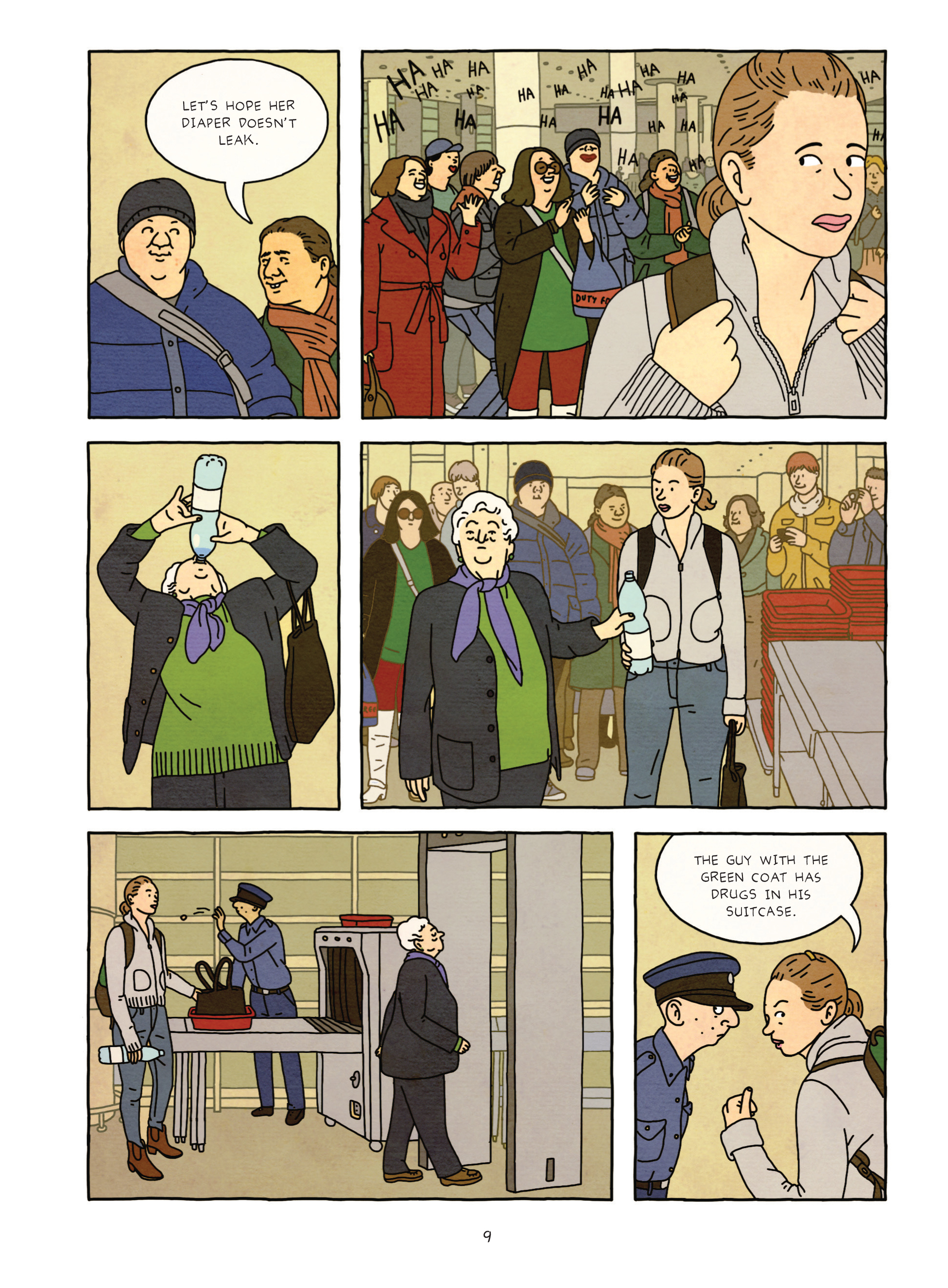
“It’s going to be the Polish ‘Persepolis,” Tomasz claims of the graphic novel about the Warsaw uprising. You can’t help but smile a little, recognizing this as perhaps not Tomasz on his work in progress, but Rutu Modan on The Property. The comparison feels natural, but on closer inspection becomes more and more blurred; Marjane Satrapi’s biographical Persepolis presents us with a monochrome story of an adolescent girl from 1970s Iran, very different to Rutu Modan’s 21st century Israeli protagonist Mica Segal, draped in Modan’s colourful style, reminiscient of a mixture of Georges Remi (or ‘Hergés’)’s The Adventures of Tin Tin mixed with the pop art style of Julian Opie on the Blue: the Best of cover. Bodies, clothes and surroundings are kept realistic, while faces are playful and sometimes exaggerated, especially noses. One strong similarity between the two texts is the unflinching and all-telling demonstration of a story of the Personal.
            The story follows Mica Segal and her grandmother, Regina, leave Ben-Gurion airport in Israel (the date is kept ambiguous as “200X.)” The internal conflicts of the region are not mentioned in the story; I have not read it, but Modan’s other work, Exit Wounds seems to deal with this more directly. The only real hint is when Mr. Popowski instigates a Krav Maga block from Mica upon learning that she is from Israel. They are heading to Regina’s native Poland, a country she left before WWII for Israel, to reclaim ‘the property’; a building that Regina’s parents owned before the war. Avram Yogdavik, an overbearing ‘friend’ of Mica’s auntie Tzilla, tags along. Mica meets Tomasz, a young Polish man giving tours of Jewish Warsaw while hiding away from Yogdavik, while Regina reconnects with a secretive past in the city.


            Right from the start we are given personal and emotive hooks; the inside covers display not an archetypal picture of Poland one might expect of the ‘Polish Persepolis,’ but an illustration of forests, houses, lakes and mountains in Sweden, complete with a little Swedish flag. Before reading the book this makes no sense, but comes to make sense as this luscious image of Sweden represents a deeply emotive point in Regina’s personal history. Even the epigraph has a personal nature, being from a family member of Modan’s.
            In the face of texts dealing with post-war Polish-Jewish identity such as Art Spiegelman’s MAUS (the only other similarity being Regina and Vladek’s shared stinginess of food,) we can see how difficult it is to pen a story of the Personal, of love, loss, and family. While embarking to locate the property, Mica suddenly witnesses a re-enactment of the Nazi’s forcing Jews onto a truck, shocking Mica and Avram into disbelief, with Avram almost forgetting that WWII is over and attacking one of the re-enacting Nazi soldiers. The history of WWII, the holocaust and uprisings against the Nazis is far from forgotten in the area, as Mica encounters tours, memorials, tourists and those in the business time and time again. Even Mica, when dealing with a melancholic Regina, brings up history as a cause before the Personal; “Is it because of Warsaw?... Is it because of dad?”


            The reader is shown both of Regina’s and Mica’s stories, in both written and pictoral form. It would be easy to make this redundant in the text, but Modan uses the scenario to bend language to exemplify the multitude of layers to the single story the reader gets. Three languages are used by the characters in the novel; Hebrew, Polish and English, each given their own font format. Mica can’t understand Polish, but speaks English and Hebrew; she speaks English with Tomasz, who also speaks Polish. Regina can talk Polish and Hebrew. Tomasz occasionally translates for Mica. When all characters are together and Polish is spoken, the reader is confronted with speech bubbles filled with squiggles, representing the incomprehensible Polish that Mica hears.
            Modan’s focus on the personal identity, history and times of the two main characters in the face of a messy multitude of factors that could easily creep in and weigh down the story creates not a ‘Polish Persepolis,’ but a unique story of emotion and self-reflection, that, yes, happens to be set in Poland, but is simply about the tragedies, victories, joys and frustrations that attach themselves to relationships with those we love and care about.