Posts

Sunday, 30 April 2017

“Perhaps if I knew them better I should like them better.” John Muir, People and Native Americans in 'My First Summer in the Sierra.'


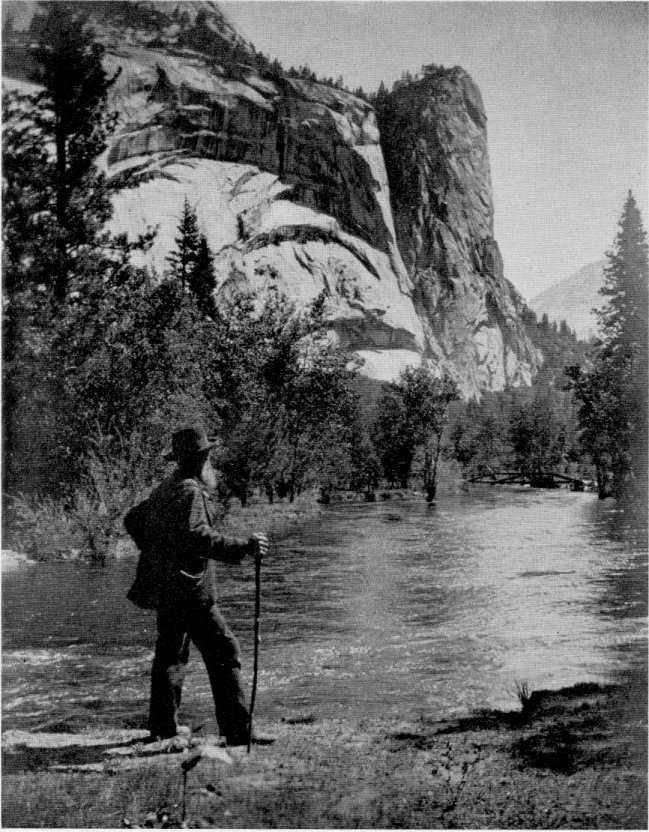
As someone interested in history, in the environment, in wilderness, conservation, and writing, I am ashamed to say that I just learned about John Muir, the late 19th century Scottish- American naturalist, last month. From a comic. Muir is famed for petitioning the U.S government for the creation of Yosemite national park, and also for his involvement in the Sierra club and other moves for conserving wilderness in the U.S. I decided to read the only of Muir’s books my library had on offer, My First Summer in the Sierra, to dip into oldey-timey conservation and naturalist writing, hoping to find connections and optimism for movements today.
            It is hard not to feel deeply for the environment as Muir sees it; he admires all life, even the ferocious bears and irritating Douglas squirrel, and laments the very undergrowth that the flock of sheep he accompanies lays waste in its trampling past. It is no surprise then, that he feels deeply the wound capitalism has created between man and the ever-connected and brotherly web of nature he sees before him. This occurs mainly in his observations of Shepherds in California, whom are degraded and exhausted by their economic strife, and may only be driven by hopes of escalating in the capitalist system by saving up to buy a flock of their own. I can think of no better summarizing image than the one Muir paints of Billy, the shepherd he accompanies, who’s clothing becomes entirely coated over time with the greasy, fatty dripping of the lunch he ties to his belt, meaning that “instead of wearing thin [his trousers] wear thick.” Billy has no emotional connection to the sheep, remarking often when one goes astray that he is not paid enough to keep saving them.
            It is thus greatly surprising, considering Muir’s deep-felt empathy for nature and his lamentations about the Arcadian shepherd being broken by American capitalism, to read his shocks and spites for Native Americans, in this era still referred to widely as ‘Indians.’ From the off Muir writes of the feeble and weak ‘Digger Indians,’ who are never specified by tribe, culture or nation, instead just a taxonomic ugliness akin to the South African settler’s naming of the ‘bushman.’ Muir frequently writes of the Indians sustenance on nature, of which he is jealous of as he and his colleagues must rely on deliveries of bread and other supplies which runs dry for an uncomfortable time. He also writes of their skill in living in their environment, as he is startled a few times by the sudden and silent appearance of a Native in their camp. Despite these admirations, he still affords them little acknowledgement for their ingenuities. He remarks on their ragged clothing, their begging for whiskey or tobacco, without really acknowledging the corrupting effect of white capitalist invasion in the same way he affords the white shepherd.
            I am sure there are a number of ways to understand his perception of native Americans, but I find it most hard to digest as a result of his perceived special ‘Scotchness,’ which I feel Muir stresses to tie him stronger to nature within the capitalist systematics of shepherding in California. When commenting on the Californian shepherds ill education, grimy food and overall depressing life, he compares it to the Scottish shepherd, whom he praises alongside the ‘Oriental shepherd’ for maintaining a keen intellect and interest in culture. Muir also retells an event where, in the dead of night, he ‘felt’ that a friend of his was nearby, and in the morning found that his friend was indeed in the valley he felt him to be in, to everyone’s surprise. This is written as being an event of extraordinary ‘Scotch farsightedness.’ I want to believe that, as result of his belief in himself as Scottish and thus different in culture etc. to other Europeans, Muir would understand other cultural uniquenesses and admire them in the same way he would admire a forested valley. I am no great scholar of Muir, but I feel that, between his heightened Scottishness and his flippancy towards the fascinating lives of Indians who understand and admire their environments as much as, if not more, than muir, exists the kind of Celtic, white-supremacist mythologizing that helped spawn various blights to the development of American culture(s) such as the Southern confederacy, which borrowed the very flag design of Scotland for their own, and also the Ku Klux Klan, who borrowed the symbolism of the 'clan' for their own twisted ends. Like I said, I am not great scholar of Muir, and also never knew him personally, but on closer critical reading I have dug up this dull residue of his understanding of the Natives of the wild lands he so greatly admires.

            I have written the above without even dipping into his mentionings of ‘Chinamen,’ some vague myths he recounts of Indian surrenders, and also an event in passing that was of interest to me, wherein he claims to have enjoyed the company of a general of the Florida Seminole wars, one of many wars between white invader and Native Americans.

Thursday, 23 March 2017

'No Human Is Illegal' Yarl's Wood Protest, December 2016.


A short piece about a protest I attended outside Yarl's Wood detention centre, in Bedfordshire.


  Flat land, torn with ploughing and roughly covered in short, sharp scrub, with sudden bursts of fat, ripe, ruby-red rosehips drooping from scraggly post-autumn bushes. Sometimes there was a hedgerow of bare hawthorn bush decorated with rich, purple- red haws. We walked around a rusted fence and over ditches to a tall, dark green metal wall with fencing clad over the top, with Yarl’s Wood detention centre within its perimeter.
            As soon as I saw their hands reaching out and waving through the tiny amount the window could be cracked open, I shed some tears and held back some unexpected sobs. Those symmetrical square windows were the only contact the detainees could have with the two thousand odd people who wanted to reach out and assure them that they were on their side. Outside the window the detainees waved, swirled whatever clothing they could, and held up notes. In some you could see the full image of a woman looking out, and occasionally a Yarl’s Wood employee loom in the room. One window had a note pasted to it, that read, in large green letters, ‘TB.’

            We get to hear from the women trapped inside by a phone hooked up to speakers; a woman waves a reusable shopping bag or laundry bag out the window and claims that this bag held everything she was allowed to take with her. She is understandably angry, desperate for freedom. Another woman, audibly distressed, says she is not getting the correct medication she needs. Another says that outbreaks of tuberculosis and other diseases spreading through the centre, as the medical facilities are sub-standard. Another says that they don’t have access to sanitary products (a speaker from ‘Movement for Justice by any Means Necessary’ says that the detention centre stopped outside organisations from bringing sanitary products, which they defined as ‘consumables’) a Polish woman says she was punched in the throat, slapped in the face, and her legs were twisted. A woman from Trinidad says she lived in Britain for sixteen years, struggling with the ridiculous bureaucratic systems for applying for the right to work, and that she eventually worked with ‘Crisis,’ helping homeless people. Some women who aren’t in Dove block, the block facing the demonstration, are locked into their rooms in other blocks, but manage to call in to say thank you for fighting for us. We hear from Mabel, a woman who has been in the detention centre for two years, who is not allowed to see her seven year old daughter. Women cry for help from the windows.
            The detention centre system in the U.K. is a disgusting anomaly within our culture. The public recoils at horrors in Guantanamo, at war crimes the world over; people continually condemn regimes such as Kim Jung Un’s and rejoice in Fidel Castro’s death, while detention centres exist within out midst, where people are interrogated, tortured, raped, abused, denied their freedom, their human rights, their ability to see their loved ones, basic feeds of the outside world like television; these people suffer in prison-like circumstances, unsentenced, simply for making it to the U.K with hopes of escaping troubles the world over, as many are seeking asylum, or of simply beginning a new phase of life, which white British people afford themselves easily the world over. Many of the detainees originate from ex-British colonies, which would have been flooded with immigration from Europe and America years ago, but as soon as that flow threatens to reverse, it is condemnable, disgusting and a crime.


At four thirty, I had to turn my back on the detention centre, leaving many innocent people trapped in their block. I had the basic right to be able to make my way home, a right you don’t always realise just how much of a luxury it is, as it appears basic, boring, and universal. And yet across the United Kingdom, detainees, who want to work, study, and live in the U.K., wait for their fate to be decided for them, while the little money and possessions are confiscated and their families await for verdict.
Just before leaving, the police boarded every bus ‘looking for someone.’ The protest had a slight police presence, just a few police liaison officers, but officers swarmed the roads and blocked either end for public access. Whether or not it was intended, their intrusion into the busses waiting to leave left an unwarranted affirmation of power and control. We could leave but for the grace of their mercy; those in the detention facility were not given such rights.
During the journey back, the coach overtakes a large red van with ‘chevaux/ horses/ pferde’ written on the back in white. In a small compartment lit up within the van, a horse turns its large, beautiful head to look through its window, out at us.


Tuesday, 21 March 2017

Thylacine


Here is a poem for world poetry day- I wrote it yesterday after watching some footage one of the last Tasmanian tigers.

Brain; neurons; eyes; glasses lens;
air (microbes, atoms, molecules);
screen protector; screen; video of you;
 84 years; camera film; light; camera lens;
air (microbes, atoms, molecules);
you. Your fur your big head your teeth. The markings on your fur;
I don’t have those, we don’t have those, you had those.
Your snout your eyes your pouch for your young.
Once your were as simple as a raindrop, a spec of sand;
Now you are a fissure of crystal, a double-helix ballet.
You are dead , and alive on my screen,
Removed from you, I do not feel your evident pain.
With you removed, a hole becomes evident, somewhere.

picture from: http://nnimgt-a.akamaihd.net/transform/v1/crop/frm/382X9zPWq9wRtCgUsbmhcAx/511c15d6-61e2-4631-91bb-009458f522e7.jpg/r0_0_1200_675_w1200_h678_fmax.jpg

Sunday, 12 March 2017

Reintroducing predators or emulating them; the missing ecological relationship in Britain.

            Near Horsham in West Sussex is a castle estate called ‘Knepp Estate,’ which, alongside farming, has let a great deal of the estate return to the wild. Medium-sized herbivores such as longhorn cattle, roe and fallow deer, Exmoor ponies and pigs roam freely on the estate. So far, these rewilding techniques have regenerated the soil’s nutrient quality, making farming once again viable near the site, whereas traditional intensive farming had rendered the soil unworkable without large quantities of chemical fertiliser; farming is finally profitable once again in the area.
            The benefits of rewilding are numerous; vastly increased biodiversity and carbon sequestration, as well as social benefits such as those George Monbiot wrote about in Feral; the sense of adventure and wonder that is lost without true, unadultered wilderness. The cause of this article is not to reiterate these benefits. I am simply looking at a common cause for human intervention in rewilding projects; fencing out or culling herbivores.
Knepp estate has had to fence off certain areas of land to guarantee that young trees and other vegetation will survive undamaged by the grazing and browsing habits of the herbivores present. It is the intensive grazing of the ‘white plague’ of sheep and other large herbivores such as deer and cattle, kept for commercial use, that has helped transform the British Isles into monolithic and expansive grassland. As a natural process in a pre-human past, grazing and other herbivorous habits helped create mosaic-like environments of grassland, scrub and woodland believed to have existed in the Pleistocene era. In the Pleistocene, however, there were predators to maintain herbivore population and also their behaviours and approaches to their environment. The herbivores that existed were also diverse in species and especially size, with even Britain hosting megafauna; the skeletons of ancient hippopotami have been found underneath central London. Interestingly enough, Knepp Estate’s aims are to add more species of herbivore, to include elk and bison.
            Dundreggan, an area that rewilding organisation Trees For Life have been working on in the Scottish Highlands, has had success by fencing out the red deer that are endemic to the area. The result has been a surge in young tree growth and inception, sometimes species that one wouldn’t expect to find, all without much human planting necessary. The biodiversity in the area is vibrant, with more than 3,000 new species recorded in Dundreggan alone. The area is lacking a natural predator, specifically the wolf; were a wolf present, the organisation would no longer need to fence out the deer, as the wolves would maintain their population by preying on the weak and sickly deer, altering the deer behaviour by scaring them away from open spaces, such as open land on the fringes of forests, and also stretches of open water where a deer may be more at risk. This has a chain reaction, that has been highlighted with the reintroduction of wolves to Yellowstone National Park in America; as the deer left open water alone, trees were allowed to grow along the waters edge, shading and cooling down the water, making it habitable for fish and other animals which helped filter the water of impurities. Knepp estate fenced off an area of newly-planted trees along the Adur river, to eventually grow to cover the water and cool it down, in a venture the Ouze & Adure River Trust termed ‘trees for trout,’ and effect which  Yellowstone has achieved through the reintroduction of natural predators.

 Tree Planting Along the River Adur at Knepp Estate. Author’s own image.


Trees for life currently run a volunteering programme called ‘project wolf’ wherein volunteers emulate wolf behaviour to scare deer away from the vulnerable rewilded areas. Many concerned with reintroducing a natural predator to the British Isles have claimed that the Eurasian lynx would be the least problematic predator to reintroduce to the British wild lands. With a Pleistocene rewilding project such as Knepp Estate, what predator should be present? If one could be decided upon, in this present day with many stakeholders in rural areas so set against the reintroduction of predators, could it be emulated, such as the project wolf campaign? The estate already cull their animals to maintain a natural population, and so the need for a natural predator has not gone unobserved. Species are being reintroduced in Britain, albeit at a slow pace, and the predator question is enshrouded in cultural myths of fear, which forces rewilding organisations to sadly intervene where another ecological relationship has been persecuted and removed over time.

Referenced: